

Chinese New Year Flowers in Thailand: Auspicious Blooms and Colours
Chinese New Year flowers in Thailand: which blooms and colours bring luck, what to avoid, and what to bring to elders in Yaowarat or send to a client.
Chinese New Year flowers in Thailand follow a short list of rules: pick red, gold or warm pink, skip anything that looks white, avoid the number four, and hand the bouquet over with both hands. This guide covers which blooms and colours count as lucky, what to bring when you visit elders in Yaowarat or Sathorn, and what to send a client before their office closes. It ends with three worked briefs you can copy.
Most English-language advice on the holiday describes Singapore or Hong Kong. Bangkok is different: the holiday is called Trut Chin here, the families who keep it are Thai-Chinese, and the flowers are fitted into a Thai home with Thai manners. Where a custom is documented we link a source. Where it varies by family, we say "ask".
Chinese New Year flowers in a Thai-Chinese household: what the day looks like
The Tourism Authority of Thailand describes Thai-Chinese families cleaning the house, holding a reunion dinner on the eve and giving red hongbao envelopes, with red as the colour of good fortune and joy. Flowers are one part of a house that has been scrubbed, dressed in red and filled with relatives.
Thai-Chinese families often talk about the holiday as three days: a shopping day, an offering day when the altar is laid and the reunion dinner is eaten, and a visiting day, when younger relatives call on grandparents with fruit, sweets and flowers. Details vary by family and dialect group, so ask which day you are expected. Altar flowers belong on the offering day; Grandma's bouquet on the visiting day.
Shops and offices run by Thai-Chinese families often close for part of the holiday, so a bouquet for a business contact has to arrive before the break. In Thai the search phrase is ตรุษจีน ดอกไม้, "Trut Chin flowers", which signals the festive palette to a Thai florist.
For the date, the Hong Kong Observatory's 2027 calendar table puts the first day of the first lunar month on 6 February 2027, and HISTORY lists the 2027 Lunar New Year period as 6 to 20 February, ending with the Lantern Festival. The reunion dinner therefore falls on the evening of 5 February.
The auspicious list: peony, orchid, chrysanthemum, lucky bamboo and kumquat
There is no single approved list, so treat this as a shortlist of lucky flowers for Chinese New Year rather than a rulebook. The Smithsonian's museum of Asian art publishes a worksheet of common Chinese symbols that gives the core meanings: peony as the "king of flowers" and the flower of wealth and honour, orchid for nobility and integrity, chrysanthemum for longevity, plum blossom for renewal, and narcissus as a beloved New Year flower because it blooms in late winter.
Peony
The peony is the closest thing to a headline flower for the holiday. Cornell Botanic Gardens calls it the "flower of riches and honor" and says red peonies are especially popular at the New Year. It is large, easy to read across a room, and pink is accepted by most families. Peonies are delicate in Bangkok's heat, so treat them as a gift for the day. Our peony page lists the pink peony sets, each paired with a second gift, and the peony's Thai and Western readings are compared in our flower meanings guide.
Orchids
Orchids carry two advantages in Thailand: nobility and integrity in the Chinese symbol tradition, and a Thai habit of treating orchids as a polite, long-lasting gift. A potted phalaenopsis or a cut-orchid arrangement is the safest Chinese New Year flower arrangement for a client, because it asks nothing of the recipient and still looks right when the office reopens. The orchids page shows the arrangements and plants we list, and our orchid care guide tells the recipient where to put it.
Chrysanthemum, with a warning
On paper, chrysanthemum is a good flower: the worksheet gives it longevity, and Cornell adds that golden or yellow chrysanthemums stand for wealth and are traditionally given to older members of the family. In practice, white and pale chrysanthemums are the flower of Chinese and Thai funerals, so the same species reads as luck in one colour and mourning in another. Choose deep gold, orange or red, and skip it for a family you do not know well.
Lucky bamboo and kumquat
Kumquat pots are the best-known Chinese New Year plant in Singapore and Hong Kong. The Asian Art Museum's New Year brochure explains why: in Cantonese the kumquat's name puns on "gold" and "good fortune", so homes and businesses are decorated with pots of the fruit. In Bangkok they are sold by plant stalls and garden centres, not florists, as is lucky bamboo, whose meaning depends on the stem count, so ask the family first. For a potted plant from us, the plants page shows the orchid plants we list.
Red, gold and pink: why colour matters more than the flower
Colour does more work than species. Ordinary red roses read as festive from the door; rare flowers in cream read as the wrong event. The TAT calls red the colour of good fortune seen on Yaowarat's lanterns and banners, and the Thailand Foundation says the lanterns represent prosperity and help ward off evil. The same applies to the wrap: the Cultural Atlas notes that gifts wrapped in red and gold denote luck, while white, blue or black wrapping has sour connotations.
Red
Red is the safe centre. Red roses, gerbera and anthurium all work and need no explanation. At FlowerRova, roses come in red, pink, white-pink and orange. For the holiday, red roses are the default choice.
Gold and yellow-gold
Gold stands for wealth in the festival's palette. In a Bangkok flower context it means warm orange-gold or bronze with a gold-toned wrap, ribbon or accent, not a spray-painted stem. Pale yellow is the tone to be careful with: the Cultural Atlas lists yellow flowers alongside white among taboo gifts, while Cornell describes golden chrysanthemums as a gift for elders. Deep gold and orange are welcome; lemon yellow on its own is a risk. Our Gold Leaf design is the Signature design to look at first for a gold-toned brief, festive without the intensity of a full red bouquet.
Pink and orange
Warm pink partners red well and suits a recipient who is not the head of the household. Orange has an extra meaning: the Asian Art Museum describes mandarin oranges as round, golden, auspicious fruit of the New Year, and many families read orange, and orange roses, as a cousin of gold. For mixing palettes, our guide to bouquet colour combinations shows what works beside red and gold.
What to avoid: white-dominant bouquets, the number four and funeral flowers
White-dominant bouquets
White is the colour of mourning in Chinese custom. In the Smithsonian's ancestor-worship interview, a family member explains that everything used at an ordinary Chinese funeral is white, and red appears only for someone who lived past 80. The Cultural Atlas puts it as a gift rule: flowers make a good gift, excluding white ones. Thai custom lands in the same place; our post on phuang reed and funeral flowers in Thailand shows what a condolence arrangement looks like here. White-pink roses are the middle case: fine if pink dominates with a red or gold accent, wrong if white dominates.
The number four
National Geographic notes that the Chinese word for four sounds like the word for death, which is why many buildings in China skip a fourth floor, and the Cultural Atlas turns it into a gifting rule: do not give gifts that add up to four. Skip 40 roses and pick 20, 30, 50 or 100. Pairs are the opposite case: the Asian Art Museum describes a pair of mandarin oranges placed with red envelopes beside each child's pillow, and a bouquet plus a second item fits that habit. Not every family minds the four, but nobody objects to avoiding it.
Funeral shapes and symbols
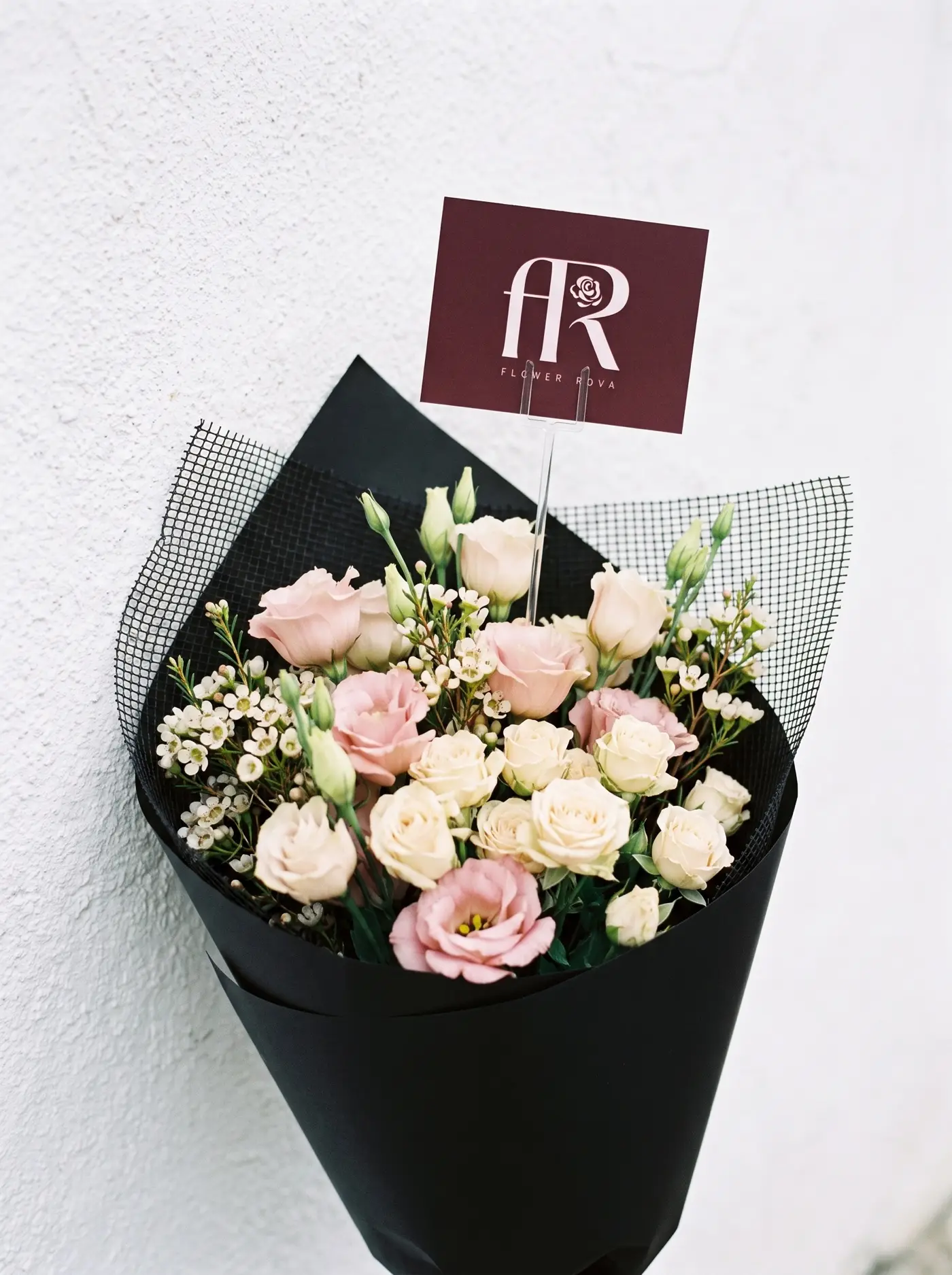
Avoid wreaths, standing sprays and black ribbon. Our matte black wrap with black mesh is the signature look of our hand-tied bouquets, and for this holiday it is the wrong wrap, for the reason the Cultural Atlas gives above. Ask us in chat about the wrap before you order.
Flowers as a visiting gift: elders, in-laws and the two-handed handover
Say you are visiting your in-laws off Sathorn on the visiting day. The flowers are a sign of respect, not the main gift, and 20 red roses with a fruit basket is a complete offering. The general rules for giving flowers to a Thai elder are in our flower giving etiquette guide, and the first visit to a partner's parents is covered in flowers for a mother-in-law; what follows is specific to the holiday.
The handover
Hold the flowers with both hands, keep them below the head level of an older person, and give a small wai once they have been taken; the Thailand Foundation's guide to the wai puts the thumbs at nose level for parents and elders, higher than for a peer. Say one sentence of greeting. "Gong xi fa cai" is widely understood, and many Thai-Chinese families of Teochew descent say ซินเจียยู่อี่ ซินนี้ฮวดไช้. If unsure, "สวัสดีปีใหม่" or "Happy New Year" is fine.
The red envelope is separate
A hongbao, or ang pao in Thai, is a separate gesture with its own rules. The TAT describes it as red envelopes of money given to younger family members, and in many Thai-Chinese families working adults also give one to their parents. It is never tucked inside the bouquet. Hand it over separately and ask a relative how the family handles amounts.
At the door and near the altar
Take your shoes off at the door and do not step on the threshold; the Cultural Atlas notes both for Thai homes. If the household has a shrine or ancestor table, it will already be dressed for the holiday, so do not place your flowers on or beside it. Hand them to a person and let the family decide where they go.
Card text for family
Keep it short, in the language the recipient reads most comfortably; the Thai phrases are in our guide to what to write on a flower card:
- "With love for the new year. Wishing you health and a full table."
- "For Grandma, with respect. Happy Chinese New Year from all of us."
- "Thank you for having us this year. Wishing the family good fortune."
Corporate Chinese New Year gifting in Bangkok: clients, partners and the office
A Chinese New Year gift in Bangkok sent to a client is read as respect for the relationship, not a sales move. The colour and number rules are the same as for family. For the wider rules, our guide to corporate flower gifting etiquette covers approvals, recipient wishes and gift policies, and the corporate page explains what we offer to companies.
Check the receiving point first
A reception desk in a Silom or Sathorn tower will sign for flowers but may not carry them upstairs, and some towers hold deliveries at a loading bay until someone comes down. A family firm in a Yaowarat or Song Wat shophouse may want them at the front counter, where the owner can see them. Ask where they should arrive and who will sign, and do not assume the most senior person is the right recipient.
Pick the closing date, not the holiday
Many Thai-Chinese firms wind down before the holiday and may stay closed for days, so a bouquet that arrives on the first day of the new year may sit unseen in a locked office. Aim for the last two working days before the break, and ask your contact for the closing date. The delivery page explains the lead times for larger counts.
Choose a scale that suits the relationship
For an ordinary client, a medium design or a plant with a hamper is the right scale; a close partner can receive a bigger bouquet in red and gold. A stand is a different gesture, and our post on grand opening flower stands in Bangkok explains when those are used; do not send one for the holiday unless the recipient has asked.
Card text for a client
- "Wishing you and your team a prosperous new year. With thanks for working with us this year."
- "Happy Chinese New Year from everyone at [your company]. We look forward to the year ahead together."
- "Gong xi fa cai. With appreciation for your partnership."
Timing: Yaowarat on the day, the florist rush and when to order
Yaowarat is the heart of Bangkok's celebration. The Thailand Foundation describes a dragon parade, lion dances, New Year markets selling auspicious goods and a main hub at the Dragon Gate near Wat Traimit, and temple visits at Wat Mangkon Kamalawat. If an elder lives on or near the road, traffic is closed or crawling, parking is hopeless, and a large bouquet is awkward in the crowd.
Programming changes year to year. The Thai government's public relations site reports Yaowarat lit from Odeon Circle to Chaloem Buri each evening in 2026, while The Nation reported that Yaowarat would not hold its main event in 2026 during the mourning period, with celebrations at malls and shrines elsewhere. Do not plan around a 2027 programme until it is confirmed.
Getting there
Go by MRT. TAT's guide to the Blue Line says Wat Mangkon station on Charoen Krung Road sits in the heart of Chinatown, a short walk from the temple it is named after; the same page points to Pak Khlong Talat, the flower market, two stops on at Sanam Chai; our flower market guide covers when to go.
The florist rush
This is reasoning, not data. TAT's February 2026 events calendar lists Valentine's events and the Chiang Mai Flower Festival among its highlights, and in 2027 the new year falls eight days before Valentine's Day. Assume florists and the flower market are busy for the whole stretch and red roses are the stem under most pressure. Our guide to Valentine's Day flowers in Bangkok covers that side.
When to order
Use the lead times as the floor, not the target.
| Bouquet size | Our lead time | A safer plan for the holiday |
|---|---|---|
| Up to 40 roses | Same day if ordered by 9 pm Bangkok time | Order two days before the date you want |
| 50 roses | Same day if ordered by 7 pm | Order two to three days ahead |
| 70 or 100 roses | 24 hours' notice | Order at least four days ahead |
| 200 roses | 48 hours | Order a week ahead |
| 500 roses | 48 to 72 hours | Order at least ten days ahead |
The middle column is our fixed lead time. The right column is advice for a busy week, not a promise, and we do not promise an arrival time. For a visit with a set dinner time, order for the day before and carry them yourself; the delivery page has the details.
Pairings: fruit baskets, sweets and hampers with flowers
Fruit baskets
Oranges and mandarins are the holiday fruit, and a fruit basket is a standard gift for a family visit. Our fruit basket gifts pair a bouquet or a Signature design with fruit, and the Gold Leaf with fruit basket keeps the whole gift in the gold palette. Check the fruit shown on each page: some families prefer pairs and round fruit, and some avoid pears.
Sweets and hampers
A hamper gives an office something to open and share on the last afternoon before the break, when a bouquet alone is one more thing for reception to look after. Our hampers page shows the sets, and the Gold Leaf with hamper matches the gold palette. For a family, chocolates beside the roses are fine.
Three worked briefs with price tokens: family visit, office, big gesture
Start with the decision table, then three worked briefs. Names and situations are invented.
| Situation | What to send | Colour | What to avoid |
|---|---|---|---|
| Visiting grandparents or in-laws | 20 red roses with a fruit basket | Red, with a gold or warm pink accent | Four stems, white-dominant bouquets, black wrap |
| Client or partner, office reception | A gold-toned Signature design with a hamper | Gold, orange and red | Stands and wreaths, a black wrap, arriving during the closure |
| Senior contact or family elder, big gesture | 100 red roses | All red | Forty or any number with four, ordering at the last minute |
| Colleague or neighbour | A small bouquet of 10 red or pink roses | Red or warm pink | White-pink with white dominant |
Brief one: a family visit
Say you are visiting your partner's grandmother in a shophouse near Yaowarat on the visiting day. Order 20 red roses, which are ฿3,299 delivered. See the 20 red roses page and pair them with a fruit basket, priced on its page.
Order two days before, so you can check them, and bring them yourself in both hands. The card: "For Grandma, with respect and love. Happy Chinese New Year." The ang pao stays in your pocket until the flowers have been taken.
Brief two: an office send
You manage a Bangkok account for a Thai-Chinese family firm in a Sathorn tower and want something at reception before the team leaves. Choose the Gold Leaf design with a hamper, priced on its page. Ask the contact for the closing date and who signs, order a week ahead and aim for the last two working days before the break.
The card: "Wishing you and your team a prosperous new year. With thanks for the year together. [Company, sender's name]."
Brief three: a big gesture
A founder wants to thank the elder who first introduced the business to their network. The gesture is 100 red roses, which are ฿8,999 and need 24 hours' notice; see the 100 red roses page. Order at least four days before, confirm the address with the family, and check that the elder will be home, because a shophouse front room with the altar laid out has less floor space than usual.
The card: "In gratitude for your guidance, and with respect. Wishing you health and good fortune in the new year."
Frequently asked questions
What are the best flowers for Chinese New Year?
Peonies, orchids, plum blossom, narcissus and red roses are the most commonly cited; the Smithsonian's symbol guide gives peony as wealth and honour and orchid as nobility. In Bangkok, red roses, pink peonies and orchids are the easiest to order. If unsure, red roses are the safe pick.
What colours are lucky for Chinese New Year flowers?
Red is the main lucky colour, with gold, orange and warm pink alongside it. TAT describes red as the colour of good fortune in Thailand's celebrations, and the Cultural Atlas says red and gold wrapping denotes luck. Avoid white-dominant bouquets, pale yellow on its own, black wrap and anything that looks like a funeral arrangement.
Can I give white flowers for Chinese New Year?
It is better not to. White is the colour of an ordinary Chinese funeral, and a bouquet that is mostly white, or white chrysanthemums, reads as condolence flowers in a Thai home too. A white-pink rose with a clear red or gold accent is acceptable; if white dominates, choose another bouquet.
How many flowers should I give for Chinese New Year?
Avoid anything with a four, including four stems and forty. Choose 10, 20, 30, 50 or 100 roses instead, and pair the bouquet with a second gift. For a family visit, 20 red roses with a fruit basket is a good size; for a client, a medium design with a hamper is usually enough.
What should I bring to a Thai-Chinese family on Chinese New Year?
Bring flowers for Chinese New Year as a gift of respect, with fruit or sweets, and an ang pao handed over separately if the family expects one. Hold the bouquet with both hands, give a small wai, and take off your shoes at the door. Our Chinese New Year page gathers our holiday picks.
When should I order Chinese New Year flowers in Bangkok?
Earlier than our minimum lead times. For 2027, the new year starts on 6 February according to the Hong Kong Observatory's table, so order the week before. Larger counts need more notice: 70 and 100 roses need 24 hours, 200 need 48 hours. Message us on LINE or WhatsApp with your date and address.