

Bouquet Wrapping: Paper, Mesh, Korean Style and Why Ours Is Black
Bouquet wrapping explained: kraft, tissue, cellophane, Korean style, mesh and the matte black wrap, plus what to unwrap at home to keep roses fresh.
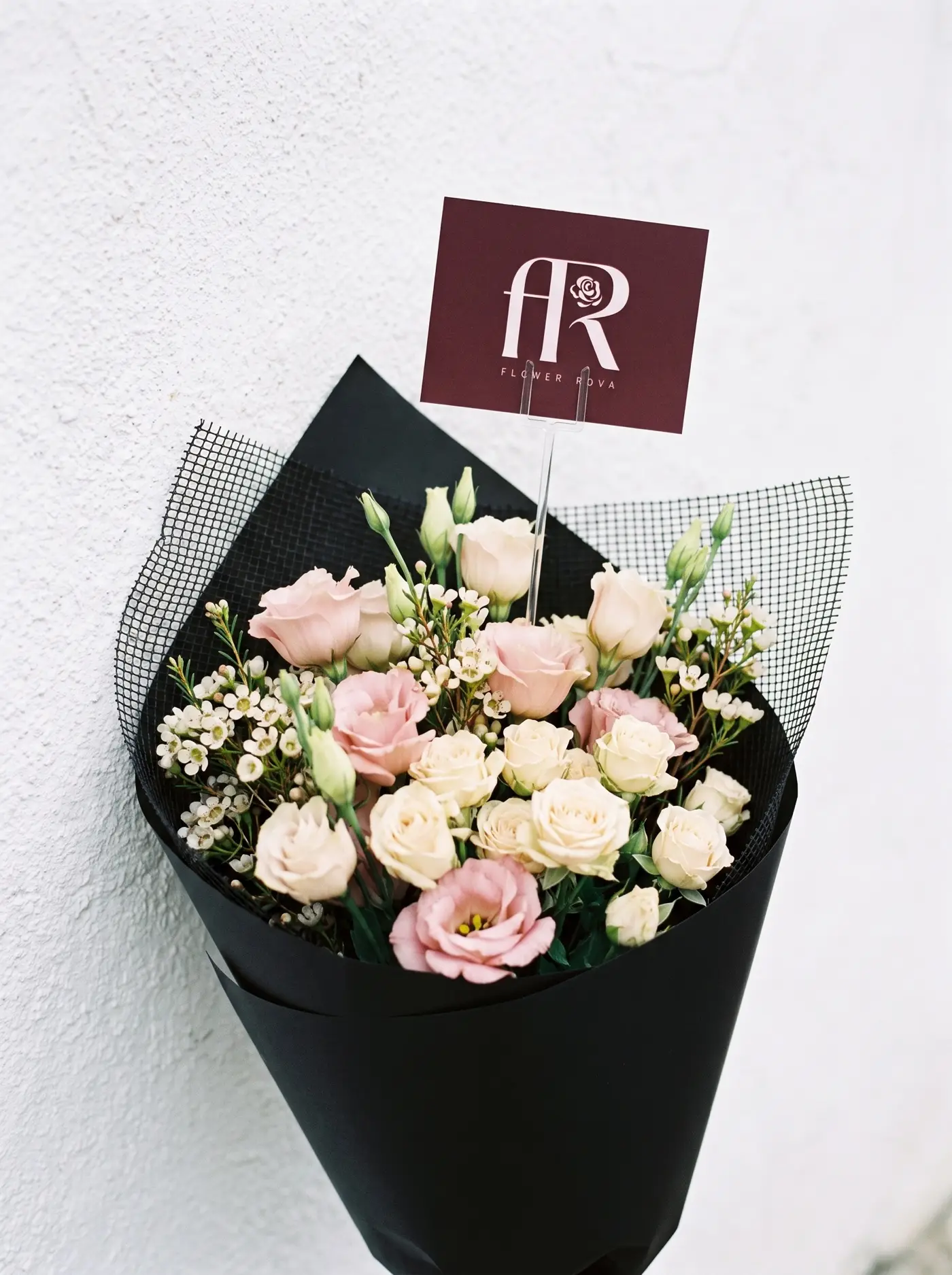
Most people judge a bouquet by the flowers and forget the thing wrapped around them. Bouquet wrapping is the first thing the recipient touches, the thing that has to survive a taxi, a lift and a doorway, and the thing that decides whether the bouquet looks like a gift or like shopping. Call it bouquet packaging if you like; florists call it the wrap. This guide covers the materials, the styles, the knot, how to wrap a bouquet yourself, what we do and why, and what to remove once the bouquet is home. If you are still choosing a shape, start with our guide to types of bouquets.
Bouquet wrapping: what it does besides look good
Bouquet wrapping has four jobs, and looks are only the fourth.
The first is protection. Rose petals bruise from contact, and the outer petals take the knocks in a bag, a lap or a doorway. A wrap is a shell, so what gets bumped is a sheet of paper rather than the flower.
The second is handling. A hand-tied bouquet is a spiral of stems held at one point. Wrapping gives the carrier a place to hold that does not squeeze the stems or snap a head off.
The third is moisture. A wrap can hold a little water against the stem ends, or trap humidity around the heads, depending on how it is made. It matters more in Bangkok than in a cool country.
The fourth is the look. A matte black wrap says one thing, kraft paper says another, a glossy pink cellophane cone says a third. None is wrong.
Kraft, tissue and cellophane: the materials and their trade-offs
Almost every wrapped bouquet you will see in Bangkok is built from some mix of three materials, plus ribbon and mesh as accents. Bouquet wrapping paper means kraft or tissue; film is the third, and the one that behaves most differently in heat.
Kraft paper
Kraft is the brown paper you recognise from the stalls at Pak Khlong Talat and from boutique florists. It is sturdy, matt and takes a crease without tearing. It reads as casual and garden-gathered, which pairs well with sunflowers, daisies and loose seasonal stems.
The trade-off is moisture. Plain paper soaks up water, softens and tears, and a bouquet that has sat in a wet carrier bag can go limp at the base.
Tissue paper
Tissue is thin, light and comes in a hundred colours; it gives a soft, layered finish and is used inside other wraps for colour and cushion. It creases, spots with water and does little to protect a head from knocks, so florists use it as an inner layer, not the only barrier.
Cellophane and film
Clear or tinted film is the workhorse of mass-market bouquets because it is cheap, waterproof and lets the buyer see the flowers. It is also the material that most affects freshness, because a closed sleeve holds humidity around the heads and does not let warm air escape.
Film is not the villain: an open-ended sleeve protects petals on a short walk or a drive without sealing them. The problem is a bouquet left fully enclosed in a warm room for hours.
The materials side by side
| Material | Protects petals | Handles moisture | Looks | Best for | Watch out for |
|---|---|---|---|---|---|
| Kraft paper | Good | Soaks up water, can tear | Casual, natural | Sunflowers, mixed stems, daytime gifts | Wet carrier bags |
| Tissue paper | Light | Spots easily | Soft, layered | Inner layer and colour accents | Not enough alone |
| Cellophane or film | Good | Waterproof, traps humidity | Glossy, see-through | Short trips, cold rooms | Sealed sleeves in heat |
| Matte coated wrap | Good | Sheds splashes | Modern, graphic | Roses, formal gifts | Coating can hold moisture in; keep the top open |
| Mesh and net | Light | Fully open | Airy, textured | Layered outer finish, air flow | Snags on clothing |
Korean-style wrapping and why it took over Asia
Korean bouquet wrapping is built from layers of coloured paper, tissue and sometimes sheer film, folded and pleated around a compact bouquet so the flowers look like they are sitting in a sculpted paper bowl. Pastel and neutral palettes, soft pleats, a slightly open top and a ribbon at the base are the common signs.
We will not claim to know exactly how it spread. What we see is that it photographs well, it is easy to carry because the paper makes a cup shape around the stems, and the layering lets a florist match the paper to the flowers, which turns a few stems into something with presence. In a city where bouquets are photographed in cafés, offices and condo lobbies before they are given, that matters. Walk past the stalls outside a university on graduation day and most of what you see is pleated paper.
What the style gets right
A paper cup shields the heads from side knocks, pleats hide the binding, and the paper colour frames the flowers so a mix of pinks looks intentional. It also suits small bunches, which is why it is popular for graduation gifts and birthday posies.
Bangkok had a presentation tradition before pleated paper arrived: the phuang malai garland, which the Bangkok Post describes as made of jasmine, marigolds and roses and offered at shrines and to elders. It has no wrap, because the flowers are the structure, and the Korean look filled a different slot: the hand-held gift bouquet.
What to be careful about
Because the paper forms a bowl, the base of the bouquet can be tightly gathered, and the heads sit in a warm pocket of air. For a quick delivery that is fine. For a bouquet that will be on a desk until the end of the day, take the layers off and let the flowers breathe. The other caution is sameness: pastel pleated paper can look like every other bouquet in the café.
Mesh, ribbon and the hand-tied knot
Three finishing details decide whether a bouquet looks finished or merely assembled.
Mesh
Mesh, sometimes called net, is a loose, open fabric that sits outside or between layers of paper. It adds volume and texture without weight, and because it is open it does not trap moisture the way a sealed sleeve does. A fine black mesh over dark paper gives depth to the outline of a bouquet.
Ribbon
Ribbon holds the wrap closed at the stem point. Satin is slippery and glossy, grosgrain is grippy and matte, raffia is natural and a little scratchy. The best ribbon grips the paper and does not slide down the stems when the bouquet is lifted.
The hand-tied knot
Under the wrap, a hand-tied bouquet is built in a spiral. The florist adds each stem at a slight angle across the previous ones, turning the bunch in the hand, so the stems cross at one point and fan out above and below. The crossing point is then bound with string or tape, and that binding is the bouquet's spine. It is why a hand-tied bouquet holds its shape without its paper.
How to wrap a bouquet by hand
If you are working from a flower kit or a bunch from the market, this is the order that works at a kitchen table.
- Strip the leaves from the lower half of each stem and lay the stems out, heads towards you.
- Hold the first stem. Add each new stem across it at a slight angle, turning the bunch a little each time, so the stems spiral and cross at one point.
- Bind the crossing point with string, tape or a rubber band. Firm, not tight enough to crush.
- Cut the stem ends level so the bouquet stands in water.
- Lay a sheet of paper as a diamond, set the bouquet on it with the binding at the centre, fold the side corners round the stems, then the bottom corner, and let the top corner fold out as a collar.
- Tie ribbon just above the binding, over the paper. Leave the stem ends uncovered so they can be re-cut later.
Two mistakes to avoid: tying the ribbon so tightly that the paper buckles, and wrapping so neatly that the recipient needs scissors. The structure lives in the binding, not in the wrap.
The FlowerRova matte black wrap and mesh: the thinking behind it
Our bouquets are hand-tied and come in a matte black wrap with black mesh. That is the signature look, and it is what you get whether you order a rose bouquet, one of the Signature designs on the bouquets page or a bouquet you built yourself. If you want to know what the materials are, ask us by chat on LINE or WhatsApp.
Here is the thinking behind a black wrapped bouquet, as a florist's judgement rather than a measured claim.
Dark wrap makes colour louder
A pale wrap lets the flowers blend into the packaging. A matte black wrap removes the background. A red rose against black reads as red and nothing else. A white-pink rose looks lighter, almost lit from within. Orange stops looking like a supermarket colour and starts looking deliberate. Roses come in red, pink, white-pink and orange, and each looks different against black than it would against kraft.
The mesh adds an edge
The black mesh sits as an outline around the wrap, giving the bouquet a shape beyond the flowers. It softens the hard line of the wrap and keeps the look from being flat. Because mesh is open, it does not seal the flowers in.
One look, many bouquets
One signature wrap also makes the bouquets recognisable. The Garnet and the Oxblood Affair are different designs, and so is a straightforward bouquet of 20 red roses, which is ฿3,299 delivered. They share the same black frame, so the recipient knows where it came from before reading the card. If you want to choose the flowers yourself, the build-your-own tool lets you, and the wrap stays the same.
A black wrap is formal and a little dramatic. For a christening or a grandparent's birthday, a lighter bouquet wrapping may suit the mood better, and we would rather say so. Our piece on what premium flowers actually means covers the quality side, and the about page explains who we are.
Wrapping and freshness: water, heat and the motorbike
This is where bouquet wrapping stops being about looks. The wrap changes the flowers' surroundings between the florist's table and your vase.
Water at the stem
Cut stems need water, and the clock starts when they are cut. The Royal Horticultural Society recommends stripping leaves that would sit below the waterline so they do not rot, re-cutting the stems with a sharp blade and conditioning them before arranging. The wrap should not make those steps harder: one sealed over the stem ends makes re-cutting a chore.
Heat and trapped humidity
Bangkok is warm for most of the year, and a closed bouquet in a closed car or a courier bag heats up quickly. A sealed film sleeve holds that warmth and moisture around the heads. An open, breathable wrap does less of that.
There is research on enclosure and cut flowers, though it is not about roses. A Thai-authored study of cut Dendrobium orchids, published in 2020, compared storage at 13 degrees Celsius in three conditions. Orchids lasted 28.33 days under controlled atmosphere, 18.15 days in modified-atmosphere packaging and 11.67 days in normal atmosphere. That is a different flower under lab conditions. It shows that the gas and humidity inside a package, with temperature, change how long cut flowers last; it does not tell you how a rose bouquet behaves in Sukhumvit traffic.
The motorbike, the BTS and the lift
Many Bangkok deliveries travel by motorbike courier, and many gifts are carried by hand on the BTS or MRT. Either way the wrap has to cope with wind, a vibrating bag, crowds and heat. Paper stiff enough to hold its shape, a binding that stops the stems sliding and no loose tails to catch in a spoke are practical features, not decoration.
If you carry a bouquet yourself, keep it upright, out of direct sun and never in a parked car.
Timing: what to do from the moment it arrives
A sequence for the first hour.
- 0 to 10 minutes. Open the front of the wrap enough to see the heads. Check nothing is bent or bruised.
- 10 to 20 minutes. Fill a clean vase with fresh water and flower food. Our guide to making roses last in Bangkok heat goes through water and placement.
- 20 to 30 minutes. Remove the wrap and any binding, strip leaves below the waterline, re-cut the stems and put the bouquet in the vase.
- Within the hour. Move it somewhere cool and shaded, away from the air-conditioner's draught.
The NC State Extension advises conditioning cut flowers in a cool, dark place for one to two hours before arranging them, and notes that commercial floral preservative works better than home remedies.
Unwrapping at home: what to remove and what to keep
Do you take the wrap off? In nearly every case yes, but not always all of it, and not always immediately.
What to remove
- Outer film or paper sleeve. Take it off before the bouquet goes into water.
- Any wrap touching the stem ends or the water. Paper left in water goes soft, and anything soft and wet in a vase gives bacteria more to feed on. Vase water needs no help, since Cornell researchers found its bacteria becoming more diverse over a week, so take every scrap of wrap out before the stems go in and follow how to clean a flower vase.
- Leaves below the waterline. The RHS makes the same point: leaves under water rot.
What to keep
- The hand-tied binding, if it is not choking the stems. It holds the spiral, and it lets you lift the whole bouquet out of the vase to change the water.
- The wrap itself, if you like it. A matte black wrap makes a decent liner for a plain vase, as long as it stays out of the water.
Water and cleaning
Use a clean vase, wash it before every bouquet and change the water often. Purdue's floral design instructor advises topping up water daily, changing the water with floral food every two to three days and re-cutting one to two inches off the stems. The same source says roses stay fresh for five to seven days, tulips and daffodils three to four.
Vase water is a place bacteria like. That is also why some hospitals ask visitors to leave fresh flowers at home. North Cheshire and Mersey NHS Foundation Trust says on its visiting page that flowers and their water can encourage bacteria and mould. Policies vary by ward, so ask the ward before you send anything to a hospital.
A worked example: the Thursday dinner in Sathorn
Say a friend is hosting dinner at her Sathorn condo on a Thursday and you want to send flowers to arrive before the guests. You order 20 red roses, ฿3,299, on Thursday morning. Bouquets up to 40 roses can go same day if ordered by 9 pm Bangkok time, but ordering in the morning rather than at the cut-off gives the bouquet the whole day to get there ahead of the guests; the delivery page explains how the tiers work. Tell us the dinner is at eight and that the juristic office can hold it. The bouquet arrives in the black wrap.
The card says: "Take the wrap off first, then put them in water. The vase matters more than the paper." That one line stops a closed parcel sitting on the counter while she cooks.
Wrapping for a gift versus for a table
A bouquet that goes into someone's hands and a bouquet that goes on a table want different bouquet wrapping, and the choice is worth making before you order.
For a gift
When someone will carry the bouquet, the wrap is the handle: sturdy, easy to hold and good-looking at the handover. A hand-tied bouquet in a firm wrap stands up in the hand and looks like a gift while it is still unopened.
For a table
When the flowers will sit in a vase at a dinner or a reception, the wrap is the first thing to go. The Emily Post Institute notes that a bouquet is a classic hosting gift, best brought in a vase or mason jar where possible. The reason is practical: a host with a doorbell ringing has no time to hunt for a container. If you cannot bring a vase, wrap the bouquet so the host can drop it into water in seconds.
Flower wrapping ideas by situation: a decision table
| Situation | Wrap style that works | Why |
|---|---|---|
| Handing it over at a doorway | Firm wrap with a clear grip | The wrap is the handle |
| Carrying it on the BTS or MRT | Sturdy paper, open top | Protects heads, lets air in |
| Bouquet will sit on a desk all day | Wrap off, into water quickly | Avoids trapped warmth |
| Dinner party or hosted table | Easy-release wrap, or bring a vase | The host needs to arrange it fast |
| Formal gift or office reception | Matte dark wrap, mesh finish | Reads as deliberate |
| Long-lasting gift | Consider dried flowers | No water, no wilting, wrap matters less |
A second worked example: the kit and the farewell
Say a colleague is leaving and you assemble a gift at your desk from a flower kit on the DIY gifts page. Each kit page, such as 10 tulips with flower kit, lists what is in the box, so check it before planning your wrap. Follow the six steps above, keep the paper loose enough to lift off in one piece, and hand it over at the end of the day rather than leaving it on the desk under the office air-conditioning. The card: "Paper off before you leave, fresh cut on the stems at home."
When wrapping is the wrong thing to fuss over
If the bouquet is for a hospital or a venue with its own rules, ask first, because the policy could rule out fresh flowers whatever the wrap looks like. And if you are choosing between a better wrap and a better rose, choose the rose; the five decisions in how to choose a bouquet put wrap last for that reason. A great wrap cannot rescue a tired flower, and our guide to telling if roses are fresh is a better place to start.
Frequently asked questions
How do you wrap a bouquet at home?
Build the bouquet in a spiral, bind it firmly where the stems cross and trim the ends level. Lay a sheet of paper as a diamond, set the bouquet on it, bring the corners up around the stems and tie ribbon just above the binding. Keep the paper loose enough to lift off in one piece and leave the stem ends uncovered for re-cutting.
Should I take the wrapping off the bouquet at home?
Yes, in most cases. Remove any film or paper that touches the stem ends or the water, strip the leaves below the waterline and put the bouquet in clean water with flower food. You can keep the hand-tied binding if it is not cutting into the stems. A short-lived sleeve is fine for the trip, but not for the evening.
What is Korean-style bouquet wrapping?
It is a look built from layered coloured paper, tissue and sometimes sheer film, pleated around a compact bouquet so the flowers sit in a sculpted paper bowl. It carries and photographs well, though the gathered base can trap warmth, so loosen or remove the layers once the bouquet is home.
Does bouquet wrapping affect how long flowers last?
It can. Water, temperature and the air around the heads all matter, and a sealed sleeve in a warm room works against the flowers. Research on cut orchids found that packaging and storage conditions changed how long they lasted, though that was a different flower in a lab. Unwrap, re-cut and stand the stems in water quickly.
Why is a FlowerRova bouquet wrapped in black?
Our signature look is a hand-tied bouquet in a matte black wrap with black mesh, whether it is for a handover or a dinner table. Black removes the background so the colour of the roses reads clearly, matte keeps reflections down and the mesh gives an outline without sealing the flowers in. It is a style choice; if a lighter look suits your occasion, message us through the contact page and we will say so.