

Types of Bouquets Explained: Hand-Tied, Round, Cascade, Box and More
Types of bouquets explained: hand-tied, posy, cascade, box and Korean wrap, and which shape holds up to Bangkok heat and a motorbike ride.
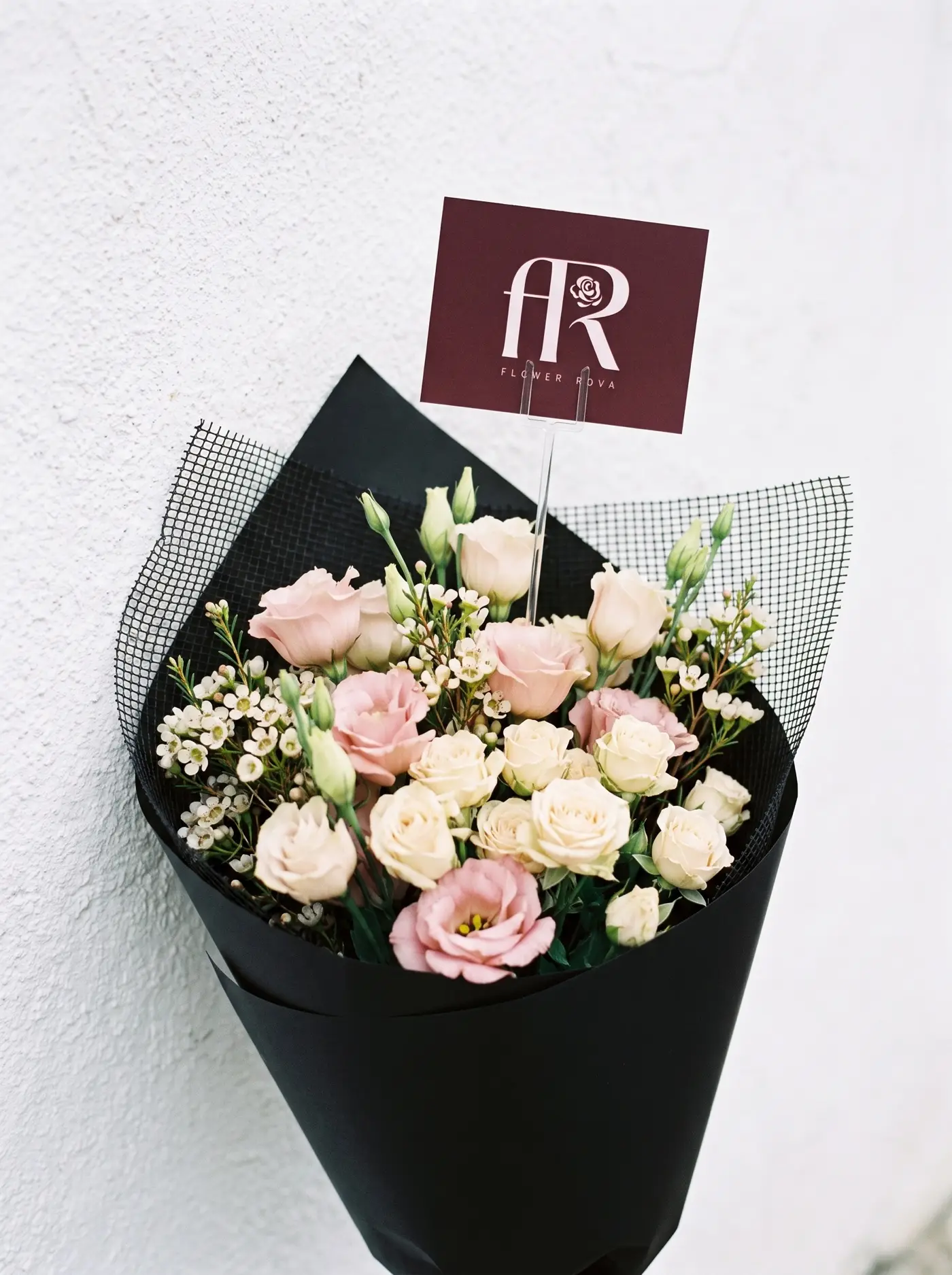
Florist captions speak in a code nobody taught you: hand-tied, posy, cascade, presentation sheaf, Korean wrap, English garden. This page decodes the main types of bouquets in plain language, so that you know what you are ordering, what it will look like on arrival, and which shapes cope with a Bangkok afternoon.
The shape decides how the flowers are held, how they drink, how they travel, and what the recipient has to do when the courier hands them over. A cascade that is a joy in a hotel ballroom is a liability in a taxi. What follows is a glossary of bouquet styles with opinions: each one is described by how it is built, then judged by one test, which is whether you would send it across Bangkok on a hot Thursday.
Types of bouquets: the seven shapes you will actually meet
Nearly everything you will be offered is one of seven shapes. The first four describe structure; the last three are as much a look.
| Shape | What it is | Held how | Best for |
|---|---|---|---|
| Hand-tied | Stems spiralled together and bound at one point, stems left long and cut flat | Gripped at the binding, or stood straight in a vase | Almost anything: birthdays, anniversaries, thank-yous |
| Round | A domed, even head, often one flower type, worked symmetrically | One or two hands | Dinner tables, formal gifts, bridesmaids |
| Posy | A small round bouquet, close to hand-sized | One hand | First dates, offices, bedside tables |
| Cascade | A shape that falls forward and down from the hand | Cradled low at the waist | Weddings and staged ceremonies |
| Presentation sheaf | Long stems laid in the crook of the arm, heads up | Cradled in one arm | Graduations, performances, awards |
| Korean wrap | Flowers layered in several sheets of paper and ribbon, designed to be seen from the front | One hand, wrap held up | Photographs, small gifts, surprise handovers |
| English garden | Loose, mixed, uneven, with foliage and different heights | Placed in a vase quickly | A host's table, a friend's flat, a slow weekend |
Two other things travel under the word "bouquet" without being one. A flower box or dome is a container, not a handheld shape, and it gets its own section below. A black wrap, which is how we dress our hand-tied bouquets, is a finish rather than a shape (bouquet wrapping has its own guide).
If you remember one distinction, make it this: the hand-tied, round and posy are built to go into water the moment they are unwrapped, while the cascade and the sheaf are built to be held for a photograph.
Hand-tied: the stems do the work
A hand tied bouquet is built in the hand, not on a table. The florist holds one stem, adds the next at a slight angle, turns the bunch a few degrees, adds another, and keeps going until a spiral forms. The spiral is the whole technique. It makes every stem cross the others at the same angle, so the heads fan out into a dome while the stems below form a cage.
That cage is why the style has lasted. Set into a vase, the stems hold the flowers up on their own, with no foam and no wire. You cut the bottom flat, add water, and the shape stays.
What a good one looks like
Check two things when a bouquet arrives. The binding point should sit just below the heads, tied tightly, with no stem slipping when you gently shake it. And the stem ends should be cut on one level, so the bouquet stands upright on a table while you find a vase.
For roses, the hand-tied form is nearly always the right default. Twenty red roses are ฿3,299, and that size is the classic hand-tied shape: a two-hand bouquet that fills a wide vase without looking sparse.
Looking after it
NC State Extension advises conditioning cut flowers in a cool, dark place for one to two hours before arranging, and says commercial floral preservative works better than home remedies. The RHS adds that you should strip leaves below the waterline so that they do not rot, and re-cut stems with a sharp knife.
Then manage the water. Purdue's floral-design instructor says roses last five to seven days and recommends topping the water up daily and changing it with floral food every two to three days. In a warm Bangkok room, treat those intervals as maximums.
Round and posy: the compact classics
A round bouquet is the formal cousin of the hand-tied. The head is a tight dome, usually built from one flower type or two, worked so that the outline is as even as a ball cut in half. No flower sticks out and no gap shows.
It suits roses, ranunculus, peonies and the full-headed hydrangea the RHS calls a mophead, a flower with a large round head of big petals. Most hand-tied rose bouquets are round in outline, so the two overlap: hand-tied describes how it is made, round describes how it looks.
The posy bouquet
A posy bouquet is a round bouquet scaled down until it fits in one hand. Think of something the size of a large grapefruit with a collar of leaves. A small bunch is also the oldest form of the love note: the RHS notes that from the 1820s to the 1880s lovers in Britain and America sent encoded bouquets, and a posy is the form easiest to hand over without ceremony.
Ten pink roses are ฿2,399 and sit in one hand and a medium-neck vase, which makes ten stems a natural posy size for a desk, a bedside table or a first date. If you are weighing ten against twenty, our guide to how many roses to send settles it by occasion.
Cascade and presentation sheaf: ceremony shapes
Both of these shapes were designed for people standing in front of an audience. Neither suits a Tuesday-afternoon gift.
Cascade
A cascade bouquet flows forward and down from the hand, like a waterfall. The top is round and full; the lower part trails with hanging blooms, ivy, orchid sprays or ribbon. It is held low, at the waist, against a dress.
Because the trailing section would flop, stems are often wired or set in a holder, so a cascade is structured rather than spiralled. That is skilled, made-to-order work, and the result is hard to put into a vase afterwards because it was never designed to stand.
Orchids are a natural cascade flower because they hang gracefully, and moth orchids are comfortable in warmth: the RHS gives a day range of 19 to 30C for the growing plant, which is an ordinary Bangkok afternoon.
Presentation sheaf
A presentation sheaf, also called an arm bouquet, is the opposite of the cascade in spirit. The florist keeps stems long, lays them flat, and wraps them loosely so that the whole thing rests in the crook of the arm with the heads facing up and out. Long-stemmed roses are the textbook sheaf.
You see it at graduations, concerts, recitals and awards, where someone is handed something dramatic and carries it for the photographs. In Bangkok that means university ceremonies and hotel ballrooms. The stems stand in a tall vase afterwards.
For wedding work, ask early
The Thailand Foundation notes that Thai engagement and wedding ceremonies are now commonly held on the same day, with morning rites for close family and an evening reception for everyone else. A bouquet may therefore need to look fresh through a morning ceremony, a gap, and an evening photograph.
Our weddings page is the place to start, and the comparison in choosing a wedding florist in Bangkok lists what to ask before you commit.
For shapes that hold well at a ceremony, look at two collection designs. The Cathedral is white oriental lily with white roses, built tall and open. The lily is also a warning: the ASPCA lists true lilies as dangerous to cats, including through vase water and pollen, so it suits a venue or a home with no cat. The Grand Ivory uses ivory roses and white lisianthus, built full and slightly loose, which is a softer choice if lilies are off the table.
Flower boxes and domes: when a bouquet is not the right form
Sometimes the form itself is the problem: the recipient has no vase, a cat, hay fever, a tiny desk, or a bed in a ward that does not allow fresh flowers. A box or a dome answers all of those.
Flower box vs bouquet
A bouquet has to be cared for: unwrapped, trimmed, put in a vase, topped up, thrown away at the end of the week. A flower box is a container with the flowers already placed, and it behaves like a decoration: you set it down and it asks nothing else of you.
That difference decides flower box vs bouquet for someone with no time, or no vase. A bouquet left in a sink while its owner works late is not a good first impression. The trade-off is that a box is built for appearance, so it usually holds fewer stems, and if the flowers are fresh they have limited access to water. If they are preserved, the roses can still be there a year later, but you cannot watch them open.
Preserved boxes and domes
Preserved flowers are real flowers treated to hold their shape and colour without water. Two examples from the preserved collection show the range.
A single preserved rose under a glass dome with a scented candle keeps the flower out of Bangkok humidity and suits a desk or a bedside shelf. Preserved roses in a larger box with a piece of jewellery suit an anniversary or a keepsake, when the flowers should still be there next year; the page lists what is in the box.
Our explainer on preserved versus fresh flowers in Bangkok humidity covers when each wins.
Cleaner, and sometimes the only option
There is a hygiene argument for the box: a dry preserved box has no vase water to change, while Cornell researchers found the bacteria in fresh-flower vase water growing more diverse within a week, as our guide to how to clean a flower vase explains.
Two other cases push you towards a box. The NHS says hay fever symptoms are worst from late March to September and lists not keeping fresh flowers in the house among self-care advice, so a preserved dome is worth considering for a sensitive recipient; ask them, or ask their doctor, because a box is not a medical measure. And some hospitals say no outright: one NHS trust asks visitors not to bring fresh flowers, citing bacteria and mould, so check with the ward before sending anything to a bedside.
Korean wrap, English garden and the FlowerRova black wrap
The Korean-style bouquet
A Korean style bouquet is about the wrapping. The flowers are often roses, ranunculus, tulips or carnations in soft colours, built into a rounded head, then wrapped in several sheets of translucent paper in layers that fan out behind the heads like a collar. A satin ribbon ties it.
It photographs well, but it is the weakest vase flower of the lot. The paper traps moisture and heat against the stems if left on, the layers soften in humidity, and the wrap is most of the value, so once it comes off you have a plain hand-tied bouquet. It suits a handover in person, not a long Bangkok afternoon.
The English garden bouquet
English garden is the loosest style. The idea is a handful of flowers that look picked on a walk: roses in different sizes, a few sprays, foliage that sticks out, nothing in an even ring.
It looks best in a vase and travels worst, because loose blooms catch on each other. Sweet peas and delphinium, the traditional British choices, wilt quickly in a warm room, so a Bangkok version leans on roses, lisianthus and sturdy foliage. Ask what is actually in it before trusting the photograph.
The FlowerRova black wrap
Our signature finish is a hand-tied bouquet in a matte black wrap with black mesh. It is a plainer answer to the paper-heavy Korean look: the wrap does not fight the flowers, and red, pink, white-pink or orange roses against matte black read as a gift rather than a craft project. A dark matte wrap also shows fewer fingermarks than pale paper. Underneath it is an ordinary hand-tied bouquet, so it can go straight into water. You can see the full range on the Signature Collection page, or build your own if you already know what you want.
Which type survives Bangkok heat and a motorbike ride
Most lists of types of bouquets leave this out. A bouquet spends time in a car, a courier box or a motorbike basket, then at a condo's juristic office or a tower reception, then in a lift, before it reaches water. The question is how much movement, heat and waiting each style tolerates.
| Type | Heat tolerance | Handles jolting | Handles waiting at reception | Verdict |
|---|---|---|---|---|
| Hand-tied (roses) | Good | Good | Good for several hours | The safest form |
| Round / posy | Good | Good | Good | Very safe; small size helps |
| Presentation sheaf | Moderate | Moderate | Moderate | Long stems snag; best handed over in person |
| Cascade | Weak | Weak | Weak | Event use only; transport boxed by a florist |
| Korean wrap | Weak to moderate | Moderate | Weak | Fine for a short, direct handover |
| English garden | Moderate | Weak | Moderate | Beautiful in a vase, fragile on the road |
| Preserved box / dome | Strong | Moderate | Strong | Best for long waits; keep upright and dry |
Rose bouquets in the hand-tied and round forms come out ahead for a simple reason: roses are strong, the spiral construction spreads the weight, and the stems stand up by themselves. The Bangkok Post reports rose bouquets as the best seller at Pak Khlong Talat around Valentine's Day.
Timing belongs in the choice
Our delivery page lists how orders move. Same-day delivery works for bouquets up to 40 roses ordered by 9 pm Bangkok time, and 50 roses by 7 pm; larger quantities need notice, and that is where a cascade or a big sheaf belongs. The tighter the shape, the more forgiving the wait.
A short routine for any type
Whatever you ordered, the first hour decides the week.
- Unwrap it within the hour. Take off the paper and mesh.
- Strip and cut. Remove leaves below the waterline and trim the stems at an angle.
- Use a scrubbed vase. The Cornell result above is the reason.
- Keep it cool. Away from the window and the air conditioner's direct blast.
- Change the water every two or three days.
Our longer guide to making roses last in Bangkok heat covers the second week.
Choosing a type by occasion and recipient
The table matches the types of bouquets above to the situations we are asked about most. Pick the situation, then read across. For the full five-step method, including size, colour and budget, see how to choose a bouquet.
| Situation | Best type | Why |
|---|---|---|
| First date or a thank-you | Posy or small hand-tied | One hand, no fuss, no vase demanded |
| Birthday, friend or partner | Hand-tied, roses | Goes straight into water, looks generous |
| Anniversary | Hand-tied, or a preserved box | Fresh for the evening, or a keepsake that stays |
| Hosting dinner at someone's home | Hand-tied, ready for a vase | It should not make the host search for scissors |
| Graduation | Presentation sheaf or round | Photographs well, held in the arm |
| Wedding | Cascade, round or hand-tied | Depends on the dress; ask early |
| Someone with a cat | Rose-only hand-tied, no lilies | Avoid toxic flowers |
| Hospital bed | Ask the ward | Some wards say no fresh flowers |
| Busy or travelling recipient | Preserved dome or box | No water, no watering schedule |
| A surprise handover in person | Korean wrap | The wrap is part of the moment |
On cats: roses themselves are safe. The ASPCA lists rose as non-toxic to dogs, cats and horses, and a rose-only hand-tied bouquet is therefore the simplest choice for a pet owner. Check any mixed bouquet for lilies first.
Worked example: a dinner at a friend's condo in Ari
Say you are invited to dinner at a friend's flat in Ari on Friday. Emily Post calls a bouquet a classic hosting gift, best brought in a vase where possible. You do not want to hand your host a bare bunch and watch them hunt for a pitcher.
The choice is a hand-tied bouquet of ten or fifteen white-pink roses from the roses range, ordered by 9 pm Bangkok time for same-day delivery. Card line: "For the table. Thank you for having us." Fifteen stems is the upper limit for a small condo.
Worked example: a university graduation
A cousin is graduating from a Bangkok university and you cannot be there. A presentation sheaf photographs well, with the heads facing the camera, while a round bouquet is safer in a crowd. For an outdoor ceremony in the heat, take the round one, around twenty roses, sent to the family's meeting point rather than the hall. Card line: "Proud of you. Dinner is on me when you are done." Ask us on LINE or WhatsApp about the hand-over time and place.
Worked example: a first date in Thonglor
You are meeting someone you have just got to know. Send nothing to their home or workplace unless they have told you where. Bring a posy of ten pink roses in the black wrap and hand it over in person at the table, or ask first where they would like it sent. Card line: "Nice to finally match the voice with the face."
One gesture is enough. If the answer is a polite thank-you and nothing else, take that as your answer and stop, warmly.
When a bouquet is the wrong type
Skip the bouquet when the recipient is in a ward that does not allow fresh flowers, has a cat and the bouquet contains lilies, will be away with nobody to add water, dislikes cut flowers or strong scent, or sits in an open-plan office where a large bouquet makes them the centre of attention. A preserved box, a dome, or a different gift altogether is kinder. Our occasions page lists other options by event.
Frequently asked questions
What are the most common types of bouquets?
The types of bouquets you will meet most are hand-tied, round, posy, cascade, presentation sheaf, Korean wrap and English garden. Hand-tied is what most florists mean by default: stems spiralled together and bound at one point, so the bunch stands up in a vase without foam. The others change the size, outline or wrapping.
What is the difference between a posy and a round bouquet?
A posy is a small round bouquet that fits in one hand, often ten stems or fewer. A round bouquet is the same dome-shaped idea at any size, usually larger and held with two hands. Both are symmetrical and both can be hand-tied.
Is a hand tied bouquet better than a Korean style bouquet?
For the recipient who has a vase, yes: a hand tied bouquet goes straight into water and survives heat better. A Korean style bouquet is a handover style, with layered paper that suits photographs and short trips. In Bangkok humidity the paper holds moisture against the stems, so remove it soon after delivery.
Is a flower box better than a bouquet?
It depends on who is receiving it. A fresh bouquet gives scent and a week of change, but it needs a vase and water. A preserved box or dome needs neither and can last a year, but it will not smell of flowers. If the recipient is travelling, has a cat or has no vase, the box is the kinder gift.
Which bouquet style lasts longest in Bangkok heat?
Among fresh flowers, a hand-tied rose bouquet is the most dependable, with roses lasting about five to seven days according to Purdue's floral-design instructor. Among all gifts, a preserved rose in a glass dome lasts longest because it needs no water. Cascades and loose English-garden bunches are the most fragile in heat.
Can you order a cascade bouquet for a wedding?
Yes, but plan well ahead. Cascade bouquets are structured by hand and need to be matched to the dress, the venue and the day's schedule. Tell us the date and venue through the contact page and we will advise on shape and timing.